
Formulation screening
Rank formulations by their stability under controlled stress.
See eight samples in parallel
Kinetic stability intelligence
ARGEN delivers Kinetic Stability Intelligence through real-time measurement of aggregation onset, rate and molecular weight change under controlled stress.
Not sure whether ARGEN fits your stability question?
Start with the five-minute assessment.
The ARGEN platform
ARGEN provides Kinetic Stability Intelligence by monitoring molecular weight change under controlled thermal, chemical and stirring stress.

Loading video…
Kinetic Stability Intelligence
Compare when samples start to change, how quickly they aggregate and which remain stable.
Illustrative 24-hour study | eight parallel samples | Mw(t)/M0
Loops automatically. Tap the chart to pause or resume; Enter or Space also works.
Workflow applications
Rank formulations by their stability under controlled stress.
See eight samples in parallelTrack aggregation onset, rate and molecular weight change.
Compare formulations under stirring and shear perturbations.
View the concentration animationCompare temperature, pH, buffer and excipient conditions.
View temperature and pH animationsExplore mAbs, proteins, peptides, RNA/LNPs and AAVs.
Add stress ranking and kinetic evidence to client studies.
Industries and services
Pharma and biotech
Compare biologic formulations with time-resolved SLS evidence.
Explore pharma and biotechFood and beverage
Investigate processing stress, protein functionality, flavor stability and shelf-life questions.
Explore food & beverageCRO/CDMO services
Give sponsors kinetic evidence for ranking and follow-up decisions.
Discuss CRO/CDMO fitResearch examples
Endpoint checks show the state at selected times. Continuous SLS adds onset, rate and divergence, helping focus follow-up with SEC, DLS, native PAGE and other established assays.
BSA | 25 °C | 500 rpm | 12 h
Loops automatically. Tap the chart to pause or resume; Enter or Space also works.
mAb | 1 mg/mL | source range 50-80 °C | 8 selected traces
Loops automatically. Tap the chart to pause or resume; Enter or Space also works.
BSA | 55 °C | logarithmic time in hours
Loops automatically. Tap the chart to pause or resume; Enter or Space also works.
Workflow fit
Choose the stress conditions, compare the kinetic paths and focus deeper characterization where it matters.
Define candidates, stress conditions and the decision threshold.
Compare up to eight samples under controlled stress.
Read onset, rate, divergence and molecular weight change.
Prioritize orthogonal assays and support model validation.
Evaluation confidence
Choose representative material and a focused condition set. Review whether the kinetic evidence answers your study question before purchase.
Research & publications
Seven publications spanning protein aggregation, mRNA, peptide stability and equilibrium characterization.
Explore foundational SMSLS research and studies that explicitly used ARGEN.
Biopharmaceutical development
International Journal of Pharmaceutics · 2026 · 127621 · Online 31 October
Study finding
Automated analysis reduced operator-related variation. Three case studies examined buffer, pH and excipient choices under thermal and stirring stress.
Relevance to ARGEN
Evaluates SMSLS, the measurement approach underlying ARGEN, for protein formulation decisions. Findings apply to the studied samples and conditions.
DOI: 10.1016/j.ijpharm.2026.127621
Full text available through the publisher. Access terms may apply.
Protein aggregation
Analytical Biochemistry · 2013 · 437: 185–197
Study finding
A multi-sample prototype tracked early aggregation of two monoclonal antibodies across temperature and concentration conditions, revealing distinct kinetic regimes.
Relevance to ARGEN
Foundational work on the SMSLS method underlying ARGEN; the paper describes a research prototype.
Full text available through the publisher. Access terms may apply.
Methods & stress testing
ACS Symposium Series · 2015 · 1202, Chapter 6: 159–188
Study finding
This book chapter describes continuous monitoring of NISTmAb and industrial antibodies under thermal and stirring stress, including air–liquid interface effects.
Relevance to ARGEN
Explains the method and experimental approach. Its 16-cell prototype is not a specification for the current ARGEN configuration.
DOI: 10.1021/bk-2015-1202.ch006
Full text available through the publisher. Access terms may apply.
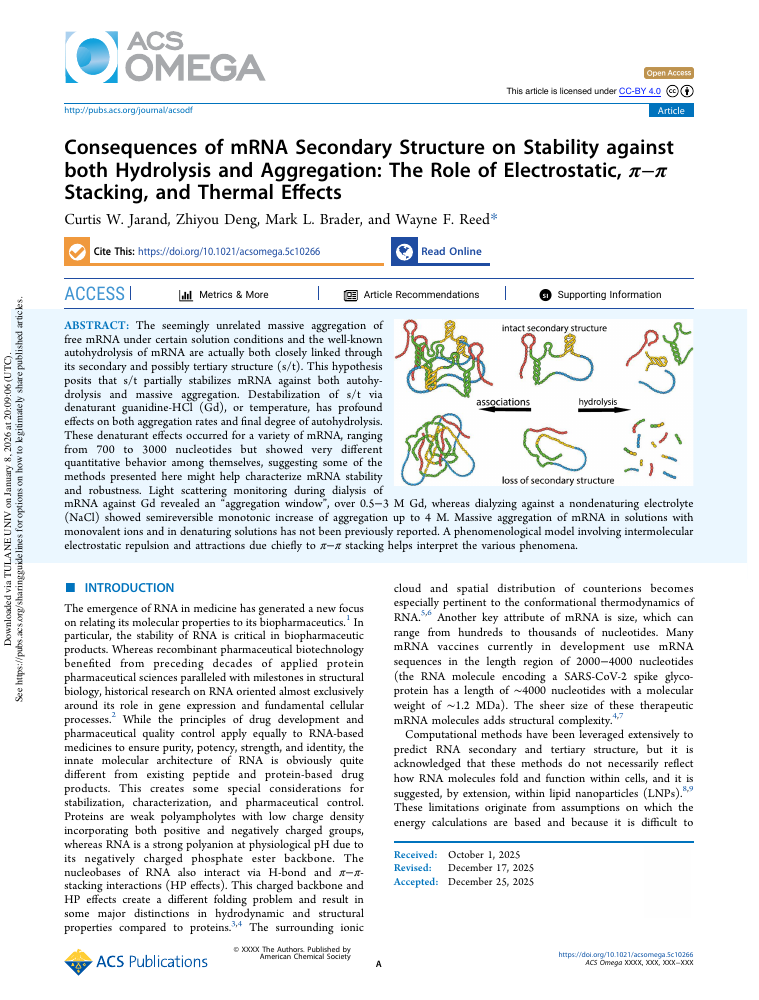
mRNA stability
ACS Omega · 2026 · 11(3): 4440–4456
Study finding
Studies of free mRNA linked secondary structure to resistance against hydrolysis and aggregation, with responses varying by RNA and solution conditions.
Relevance to ARGEN
Methods explicitly use ARGEN for static light scattering alongside DLS and a custom dialysis device. This is free-mRNA research, not LNP formulation validation.
© 2026 The Authors. Published by American Chemical Society.
Licensed under CC BY 4.0.
Thumbnail: reduced-size article opening page. PDF unchanged.
Aggregation reproducibility
The Journal of Physical Chemistry B · 2018 · 122(40): 9361–9372
Study finding
For BSA and one monoclonal antibody, thermal aggregation was reproducible within instrumental error, while contact-stir aggregation showed greater variability.
Relevance to ARGEN
Uses ARGEN to distinguish measurement uncertainty from variability in the aggregation process under the tested conditions.
Full text available through the publisher. Access terms may apply.
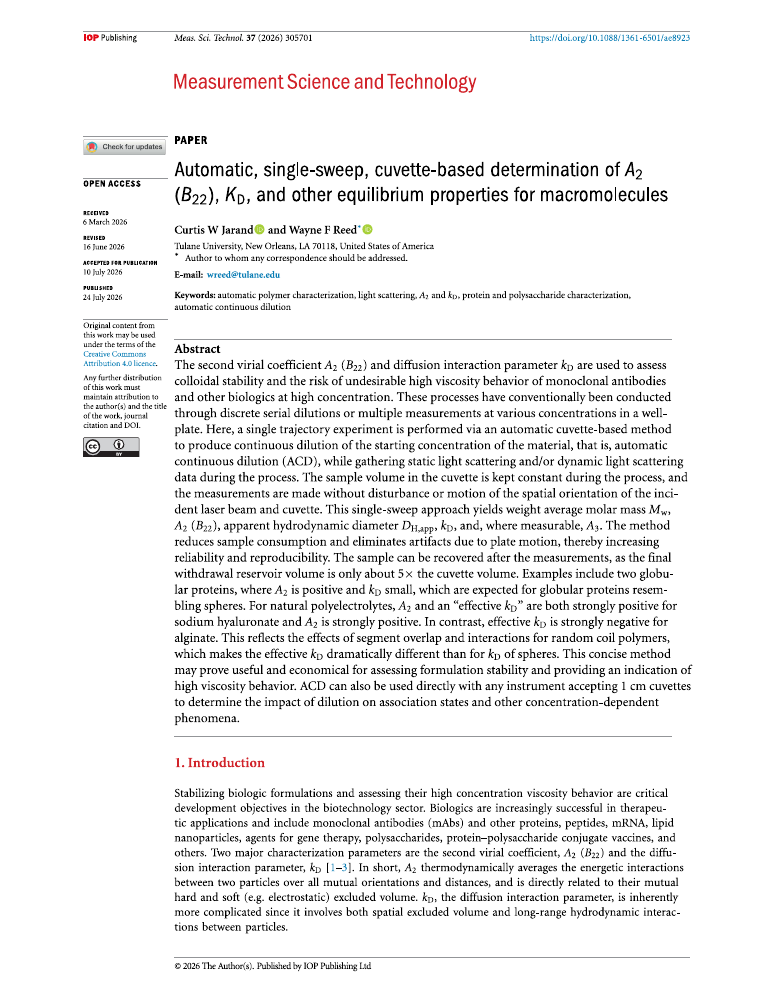
Equilibrium characterization
Measurement Science and Technology · 2026 · 37: 305701
Study finding
An automatic continuous-dilution method measured concentration-dependent properties of proteins and polysaccharides in a single cuvette.
Relevance to ARGEN
ARGEN supplied static-scattering measurements of molar mass and A₂. Kᴅ came from a separate DLS instrument; the study used custom dilution hardware.
© 2026 The Authors. Published by IOP Publishing Ltd.
Licensed under CC BY 4.0.
Thumbnail: reduced-size article opening page. PDF unchanged.
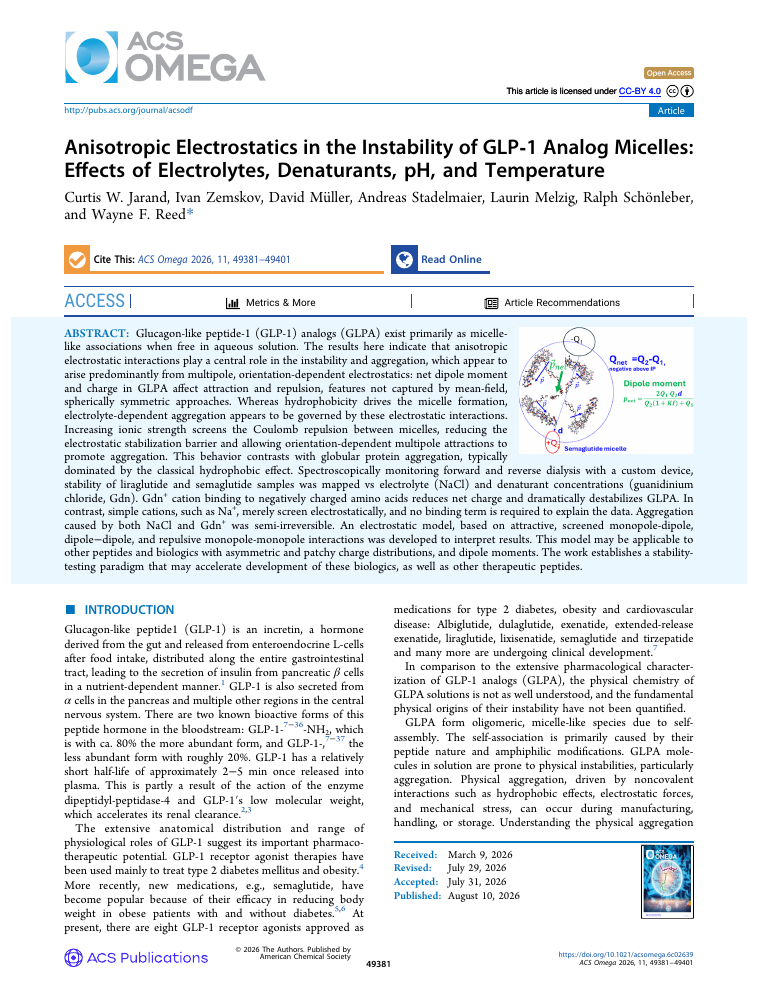
Peptide stability
ACS Omega · 2026 · 11: 49381–49401
Study finding
Liraglutide and semaglutide experiments linked aggregation to electrolyte-dependent electrostatic interactions and mapped responses to denaturant and pH.
Relevance to ARGEN
Uses ARGEN static light scattering alongside DLS and custom dialysis to investigate GLP-1 analog solution stability.
© 2026 The Authors. Published by American Chemical Society.
Licensed under CC BY 4.0.
Thumbnail: reduced-size article opening page. PDF unchanged.
Findings apply to each study’s samples, methods and conditions. Research instruments and custom accessories may differ from the current commercial configuration. Open-access PDFs and previews are credited under CC BY 4.0. Other publications link to their publisher records. Inclusion does not imply endorsement by the authors or publishers.
Explore the publications library →Kinetic stability resources

Featured webinar 30 min
High-throughput kinetic evaluation in formulation development. Registration on Yokogawa.
Interactive assessment
Check whether ARGEN fits your study before planning the experiment.
Method brief
Review the method for one formulation or developability decision.
Get the brief
Studies & applications
Technical note
Thermal-stress RNA monitoring across buffer systems.
Read RNA noteCase study
Concentration-dependent aggregation under stirring stress.
Read stirring studyIndustry case
Flavor, protein, oxygen and shelf-life applications.
Review food and beverage caseApplications & service
Ask about applications, specifications, studies or service. The assistant uses approved ARGEN evidence and routes questions to the team when needed.
Start discussion
Tell us about your stability question.
View the ARGEN product page